The short answer: Most high school athletes should email a list of about 20 to 30 colleges, spread across levels: NCAA Division I, II, and III, NAIA, and junior college. That's enough schools to create real opportunities while still letting you personalize every email.
How many colleges should you contact?
One of the first big questions every high-school recruit faces is:
“How many colleges should I contact if I want to get recruited?”
Most athletes either:
- reach out to too few schools and wonder why no one replies, or
- blast every coach in America and hope someone bites.
Both approaches miss the mark.
The sweet spot?
👉 A strategic, personalized list of 20–30 colleges — across multiple levels (D1, D2, D3, NAIA, and JUCO).
Here’s why that range works, how to build a balanced college list, and how coachoutreach.com can build your entire list automatically in seconds.
Why is 20 to 30 colleges the right range?
Most athletes don’t get recruited by the first school they email. Or the second. Or even the tenth.
Recruiting is a numbers game — but not a spam game.
You want a list that is:
- Large enough to give you real opportunities
- Small enough to personalize your communication
- Diverse enough to match your athletic + academic level
Here's why 20–30 schools is ideal:
✅ 1. Coaches respond at wildly different rates
Some programs reply fast. Others rarely respond but still track you. A bigger list gives you more shots on goal.
✅ 2. Your interests will change
As you grow, improve, or discover new programs, your list will shift.
Starting with 20–30 gives you room to refine.
✅ 3. You need a mix of competitiveness levels
Not every athlete is a D1 athlete.
Not every athlete should go JUCO.
A balanced list gives you options.
✅ 4. Recruiting is unpredictable
Coaching changes, roster needs shift, injuries happen, and scholarships move.
A 20–30 school list protects you from chaos.
How should you split your list across divisions?
A strong, realistic list should include:
⚡️ D1 (5–8 schools)
Dream or high-target schools.
These push you. Some may be reach schools — that’s OK.
⚡️ D2 (6–8 schools)
These offer strong athletics + solid academic fit.
A great category for many recruits.
⚡️ D3 (4–6 schools)
No athletic scholarships, but often fantastic academics and competitive sports.
⚡️ NAIA (3–5 schools)
Under-recruited gem.
These schools recruit aggressively and love athletes who show interest.
⚡️ JUCO (2–3 schools)
The most underrated path.
Perfect for athletes needing development time or academic rebuilding.
This mix gives you top options, realistic pathways, and guaranteed opportunities.
How do you build a college list without guessing?
Most athletes build college lists by:
- googling around
- asking teammates
- grabbing random names
- hoping for the best
That process is slow, outdated, and rarely accurate.
Plus, you have no idea:
- who the coaches are
- where to find their Instagram or X profiles
- what their email addresses are
- whether the program actually fits your goals
That’s why smart athletes are now building their lists with coachoutreach.com.
How can Coach Outreach help you build your list?
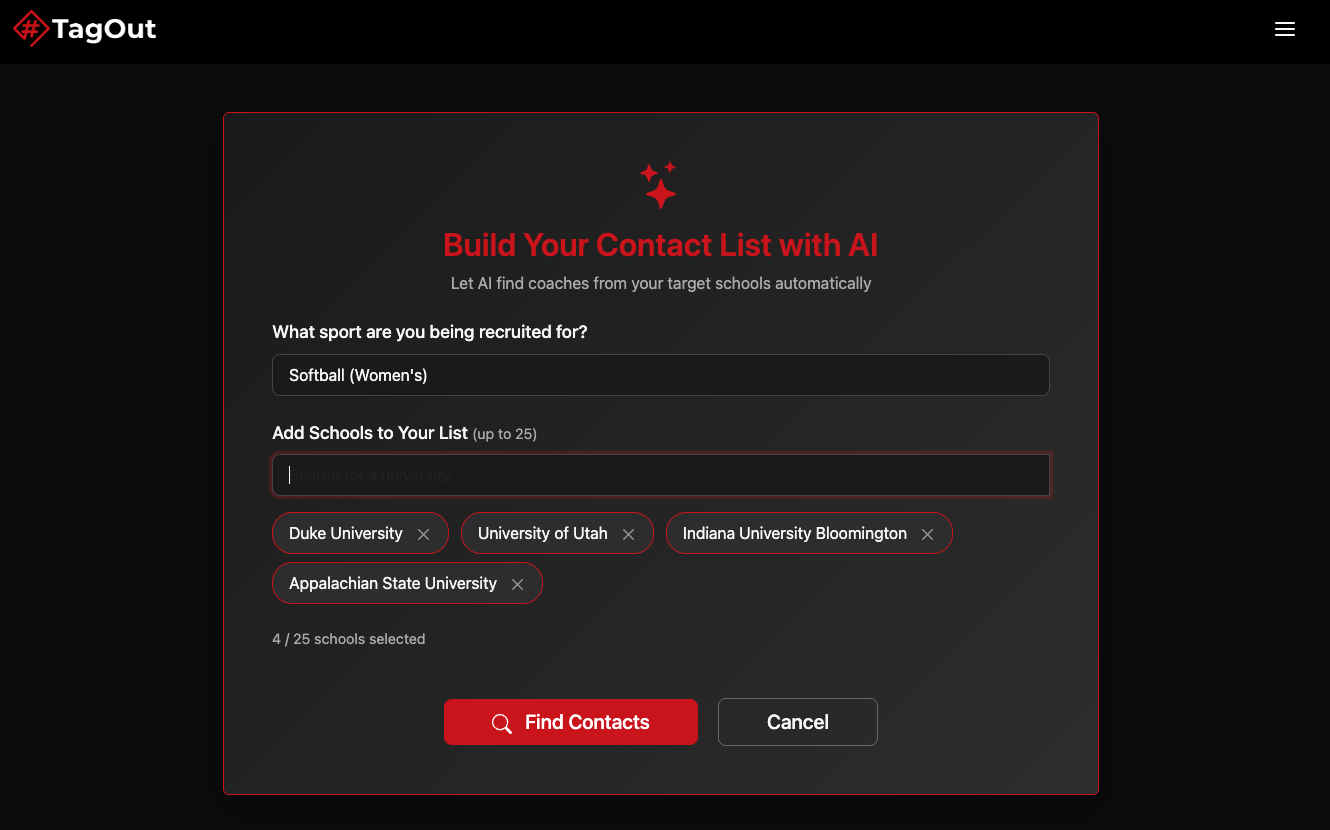
coachoutreach.com includes a built-in AI-powered College List Builder designed specifically for high school athletes.
Here’s what it does:
✨ 1. You choose the schools you’re interested in
Pick D1, D2, D3, NAIA, or JUCO programs — or mix them any way you want.
✨ 2. CoachOutreach’s AI Researcher does the hard work
In seconds, the system automatically gathers:
- Every coach’s email address
- Twitter (X) profile
- Instagram profile
- Recruiting coordinator info
- Head coach + assistant coach details
Instead of spending 10+ hours researching, you get a complete contact list instantly.
✨ 3. Your list turns into a communication plan
Once your list is built, you can:
- email every coach directly
- tag coaches on Instagram and X with one post
- send highlight updates
- track who opens and clicks
- follow up intelligently
This is recruiting done the modern way — fast, organized, and effective.
Why does your college list matter so much?
When you have a great list:
- Your emails are more personalized
- Your highlights get seen more often
- Coaches understand your genuine interest
- You build relationships over months, not days
- You dramatically increase your odds of finding the right fit
A bad list = wasted time.
A great list = real conversations with real opportunities.
And with coachoutreach.com, you don’t have to guess anymore.
🏁 Final Takeaway: Contact 20–30 Colleges, Not 3 or 300
If you want real recruiting traction, here’s your formula:
✔ Build a list of 20–30 colleges
✔ Include D1, D2, D3, NAIA, and JUCO programs
✔ Use coachoutreach.com to research and build your list instantly
✔ Email coaches consistently (every 4–6 weeks)
✔ Update them with highlights, tournaments, progress
Your college list isn’t just a spreadsheet —
it’s your recruiting roadmap.
With a balanced list and an AI-powered research tool doing the heavy lifting, you’ll get in front of the right coaches faster and with far less stress.
Frequently asked questions
How many colleges should I email?
About 20 to 30, spread across NCAA Division I, II, and III, NAIA, and junior college programs that fit your level, academics, and goals.
Is it bad to email 100 or more coaches?
It isn't against any rule, but it's hard to personalize that many emails and keep up with follow-ups. Start with 20 to 30 schools that truly fit, and add more as your interests change.
Should I include schools that might be out of reach?
Yes, a few. Balance those reach schools with programs where you're a realistic fit and a few where you'd likely be a strong recruit.