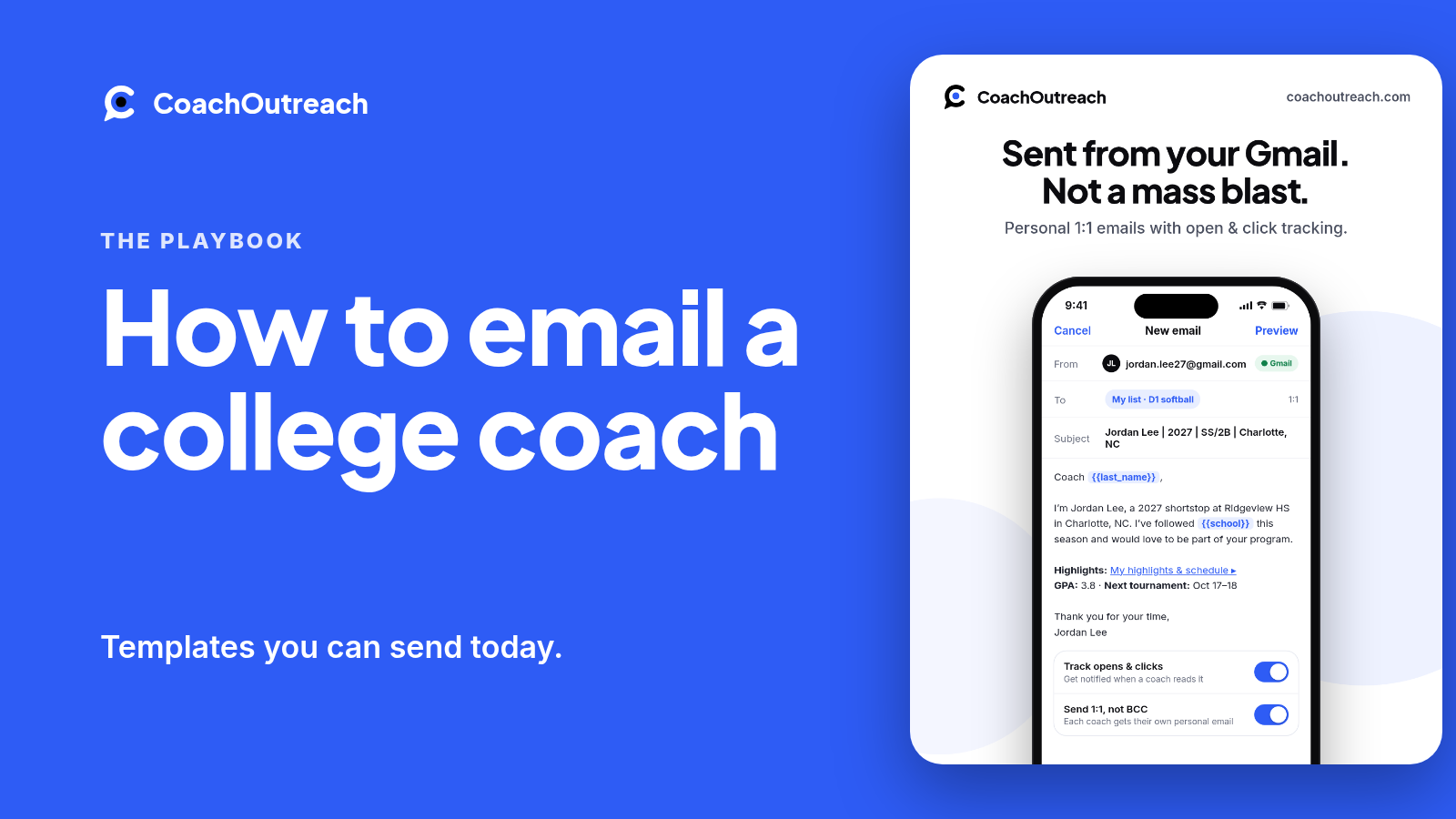
The short answer: Email each coach individually from your own email address, with a subject line that shows your name, graduation year, position, and hometown. In the body, write five or six short sentences: who you are, why you're interested in that specific program, your key stats and grades, a link to your highlight video, and where the coach can see you play next.
Your first email is how most college coaches will learn your name. It doesn't need to be clever. It needs to be easy to read on a phone and give a busy coach everything they need to decide whether to look closer. Below is a simple structure, three example emails you can adapt, and the mistakes that get emails ignored.
What should you include in an email to a college coach?
Every first email should answer the questions a coach has when they open it:
- Who are you? Full name, graduation year, position, high school, and club or travel team.
- Why this program? One specific sentence about their school or team, such as an academic program, their style of play, or a game you watched.
- What can you do? Two or three of your most relevant stats or measurables. Not your entire résumé.
- How are your grades? GPA, plus test scores if you have them.
- Where can they see you? A link to your highlight video and your upcoming tournament or showcase schedule.
- How do they reach you? Your phone number and email, plus your high school or club coach's name and contact information.
How do you write a subject line a coach will open?
Coaches sort recruits by graduation year and position, so put that information in the subject line where they can see it before opening. A simple format works best:
Name | Grad year | Position | City, State, for example: Jordan Lee | 2027 | SS/2B | Charlotte, NC
If you're writing about a specific event, add it: Jordan Lee | 2027 SS | Playing at the Fall Classic, Field 4, Oct 17.
How long should your email be?
Short enough to read on a phone without scrolling much: roughly 100 to 200 words. Coaches can always click your video or reply for more. A long email with every stat from every season is harder to read, not more impressive.
How do you send it step by step?
- Pick the right coaches. Find the head coach and the assistant who handles recruiting for your position on the school's athletics staff page.
- Write one strong template. Use the structure above and keep it under about 200 words.
- Personalize every email. Use the coach's name and change the "why this program" sentence for each school.
- Send each email individually. Never put a list of coaches in the To, CC, or BCC line. Each coach should get an email addressed only to them.
- Send it from your own email. Use an address you check every day, ideally one with your name in it, so replies come straight to you.
- Write down when you sent it. You'll want to follow up in a couple of weeks, and you'll want to know who opened it.
What do good college coach emails look like?
Here are three examples. Swap in your own details, and keep the personalized sentence about each program truly specific.
Example 1: Your first introduction
Subject: Jordan Lee | 2027 | SS/2B | Charlotte, NC
Coach Martinez,
My name is Jordan Lee, and I'm a 2027 shortstop and second baseman at Ridgeview High School in Charlotte, NC. I also play for the Carolina Elite 16U travel team.
I've followed your program this season, and I like how your middle infielders are trusted to run the defense. I'm also interested in your exercise science program.
This summer I hit .410 with a .520 on-base percentage. My GPA is 3.8.
Highlights and schedule: [link to your video]
Next tournament: Fall Classic in Greensboro, October 17–18, Field 4.
Thank you for your time. I'd love to learn more about your program.
Jordan Lee
(704) 555-0123 · [your Gmail address]
Travel coach: Coach Dana Price, (704) 555-0188
Example 2: Leading with academics
Subject: Maya Brooks | 2026 | Center Back | Columbus, OH
Coach Allen,
I'm Maya Brooks, a 2026 center back at Westfield High School in Columbus, OH, and I play club soccer for [Club Team Name].
I'm looking for a school where I can study engineering and keep playing at a high level, and your program stood out because so many of your players are in STEM majors.
I have a 4.1 weighted GPA and a 1380 SAT. I'm 5'9", a starter for both my high school and club teams, and I was team captain this fall.
Here is my highlight video: [link]. My club schedule for this winter is here: [link].
I would appreciate the chance to visit campus or attend one of your ID camps.
Maya Brooks
(614) 555-0147 · [your Gmail address]
Club coach: Coach Ray Okafor, (614) 555-0110
Example 3: Before a tournament or camp
Subject: Sam Carter | 2027 RHP | Playing at the Fall Showcase, Nov 7–8
Coach Nguyen,
I'm Sam Carter, a 2027 right-handed pitcher from Richmond, VA. I'll be playing at the Fall Showcase in Raleigh on November 7–8 and wanted to share my schedule in case your staff is attending.
Saturday 10:00 a.m., Field 2 · Sunday 1:30 p.m., Field 5 · Jersey #14 (Richmond Thunder)
My fastball sits 82–84 mph, and I have a 3.6 GPA. My most recent bullpen video is here: [link].
I'm very interested in your program and hope to meet you there.
Sam Carter
(804) 555-0161 · [your Gmail address]
What mistakes should you avoid?
- Mass emails. A list of coaches in the To or CC line tells every coach they're one of many.
- The wrong school's name. Copying a template and forgetting to change "Coach Smith" or the school name is the fastest way to be ignored. Read every email before you send it.
- A parent writing as the athlete. Parents can help, but coaches want to hear from the athlete. The email should sound like you.
- No video link. If a coach can't see you play, there's not much they can do next.
- Attachments. Use links instead. Large attachments are often blocked or ignored.
How do you know if a coach read your email?
Most of the time you won't get a reply right away, and that doesn't always mean a coach isn't interested. If you use an email tool with open and click tracking, you can see which coaches opened your email and clicked your highlight link, which tells you who to follow up with first. Coach Outreach is an iPhone app that sends your emails one-to-one from your own Gmail and shows you which coaches opened them and clicked your links. You can start free.
Not sure how often to write after this first email? Read how often to email college coaches, and if you're still building your list, see how many schools to email.
Frequently asked questions
Should I email the head coach or an assistant coach?
Email both when you can: the head coach and the assistant who handles recruiting for your position. Send each one their own email rather than putting them on the same message.
When can college coaches reply to my email?
NCAA rules limit when Division I and Division II coaches can respond to recruits, and the dates vary by sport. If you're early in high school and don't hear back, it may be because of those rules, so keep sending updates. Division III, NAIA, and junior college programs have fewer restrictions.
Should my parent send the email for me?
No. Parents can help find schools, proofread, and keep track of who responded, but the email should come from the athlete and sound like the athlete. Coaches are recruiting you, not your parents.
Is it okay to use the same email for every coach?
You can reuse the same structure, but change the coach's name and the sentence about why you're interested in that program for every school. A generic email is easy for a coach to spot.